A Violin Built Today May Still Be Played in 200 Years
- Marco Osio
- Mar 13
- 4 min read

We live in a time when most objects are designed to be replaced.
Phones, furniture, tools — the assumption built into nearly everything we use is that it will eventually become obsolete, break down, or simply be superseded by something newer.
The violin refuses this logic entirely.
The instruments built in Cremona three hundred years ago by Antonio Stradivari and Giuseppe Guarneri del Gesù are not in museums. They are on stage. They are played tonight, in concert halls across the world, by musicians who depend on them as their primary working instruments.
This is not nostalgia. It is not sentimentality. It is the result of a way of making things that placed permanence — not convenience, not speed, not cost reduction — at the center of every decision.
That philosophy is still alive in Cremona. It is what guides the work in my workshop today.

The materials chosen for how they age, not only for how they perform
A handmade violin is built from a small number of natural materials: spruce for the top plate, maple for the back and ribs, hide glue, and a carefully prepared varnish.
What makes these choices remarkable is not their simplicity. It is their intentionality.
Spruce and maple, when properly seasoned — in my workshop, I work with wood aged a minimum of ten years before it is ever cut — do not deteriorate over time. They transform. The cellular structure of the wood changes slowly, gradually becoming lighter and more resonant. A violin that has been played for decades often responds more freely than a new one. Its sound becomes richer, more complex, more personal.
This is not a side effect. It is a feature that Cremonese makers understood centuries ago and built into the instrument's design.
The varnish, too, is chosen not only for its visual beauty — the amber, orange, and gold tones that characterize the Cremonese tradition — but for its acoustic behavior over time. A varnish that is too hard will constrain the wood. One that breathes with the instrument allows it to keep evolving.
Every material decision is, in some sense, a decision about the future.

Built to be repaired, not replaced
One of the least visible aspects of violin making — and one of the most important — is that the instrument is designed to be opened.
The violin is assembled using hide glue, a traditional adhesive that bonds with exceptional strength but can be released with controlled heat and moisture. This means that any part of the instrument can be accessed, repaired, or replaced by a skilled maker without compromising its identity or its value.
A crack in the top plate. A worn bass bar. A structural adjustment needed after decades of use. All of these can be addressed. I have worked on instruments that carry generations of repairs, each intervention documented in the wood itself — a kind of material memory.
This approach to construction requires more thought, more time, and a deeper understanding of how the instrument will age. It is the opposite of designing for obsolescence.
In a violin, repairability is not a technical afterthought. It is a core value built into the structure from the first cut.

An instrument that belongs to more than one life
A handmade violin does not belong to a single musician.
It may pass from teacher to student, from parent to child, from one generation to the next — carrying with it the sound of every hand that has played it, every hall it has filled, every musician who has depended on it.
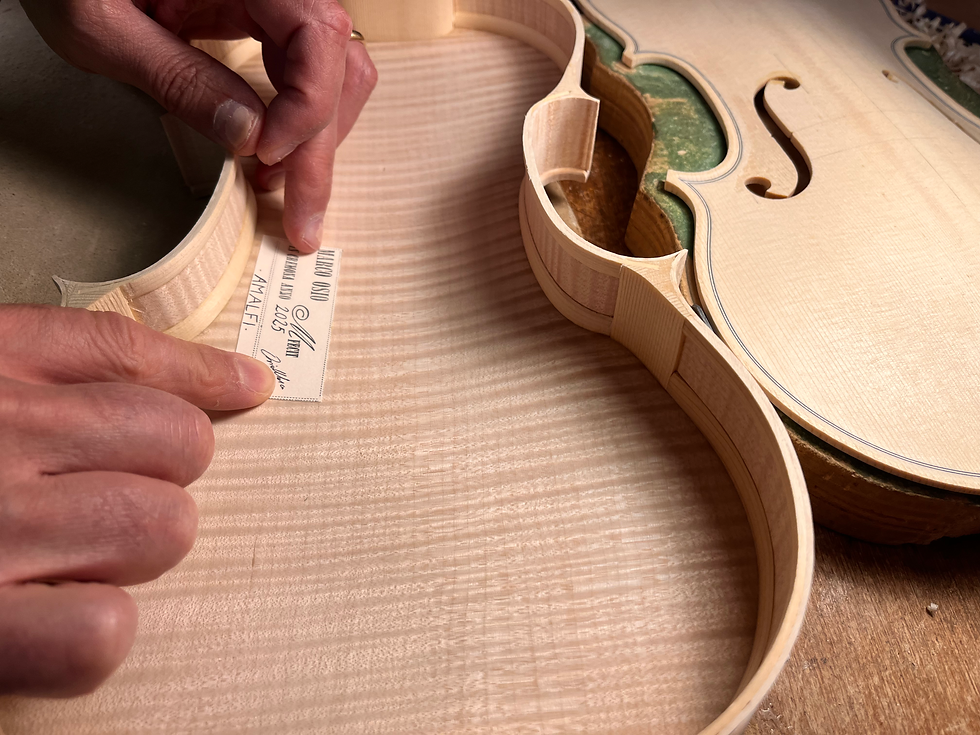
When I finish a violin in my Cremona workshop, I am aware that its life will extend far beyond my own. The instrument I complete today may still be played a hundred or two hundred years from now, by musicians I will never meet, in places I cannot imagine.
Each player will leave a trace in its voice. Each generation will shape it slightly differently.
The violin, in this sense, is never truly finished. It simply continues.
(In this video I compare two handmade violins from my Cremona workshop, showing how instruments continue to evolve with time and playing.)
What this means for the people who choose one
Choosing a handmade violin is not a purchase in the conventional sense.
It is a decision to become part of a longer story — one that began in Cremona centuries ago and will continue long after the current owner has set the instrument down for the last time.
The musicians and collectors who commission instruments from my workshop understand this. They are not looking for a product. They are looking for an object with a future.
That is what Cremonese lutherie has always offered. And it is what I try to put into every instrument I build.
If you would like to learn more about the instruments made in my Cremona workshop, you can find my work and the current waiting list at www.marcoosio.com.
Marco Osio is a violin maker based in Cremona, where he builds handmade instruments inspired by the Cremonese tradition. Each violin is crafted entirely by hand in his workshop, with the aim of creating instruments that will grow and evolve with the musicians who play them.