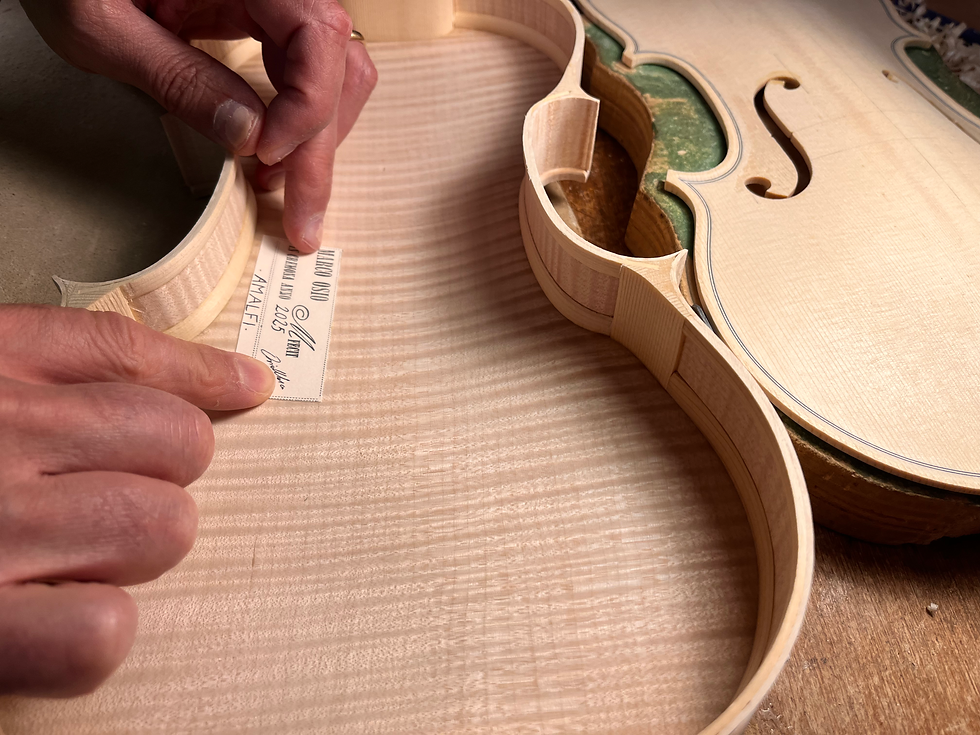
Cremona Violin Maker: Where Tradition Becomes Sound
- Marco Osio
- Mar 1
- 3 min read

There is a moment, late in the evening, when the workshop finally becomes silent. The tools rest on the bench, the scent of spruce and maple fills the air, and the violin—still unfinished—waits patiently.
This is how every handmade Italian violin begins its life in Cremona.
Being a Cremona violin maker means more than building an instrument. It means continuing a tradition that has shaped the sound of music for over three centuries. In this small Italian city, Antonio Stradivari and Giuseppe Guarneri del Gesù created instruments that are still considered the highest achievement in violin making.
Today, that tradition continues—not in museums, but in working workshops.

Cremona: The Living Center of Violin Making
Cremona is not simply a historical reference. It is a living environment where violin making is still practiced as a daily discipline.
Walking through its streets, you encounter workshops where instruments are built entirely by hand, just as they were centuries ago. The knowledge is transmitted not through machines, but through experience, observation, and repetition.
As a Cremona violin maker, I am part of this continuous lineage. Every instrument I build reflects both tradition and personal interpretation.
The goal is not to replicate the past, but to extend it into the future.

The Beginning: Selecting the Tonewood
Every handmade violin begins with the selection of tonewood.
The top plate is made from spruce, often sourced from the Val di Fiemme in the Italian Alps. This wood is chosen for its unique combination of lightness, elasticity, and acoustic efficiency.
The back, ribs, and scroll are made from maple, selected not only for its beauty but also for its structural and acoustic balance.
Each piece of wood is different. Grain structure, density, and elasticity vary, and these differences will influence the final voice of the instrument.
The violin maker must recognize the potential hidden within the material.
The Handmade Process: Precision and Sensitivity
The transformation from raw wood to finished violin requires months of precise and sensitive work.
The arching of the plates is carved entirely by hand. This curvature determines how the instrument vibrates and projects sound.
Thickness is refined gradually, guided by experience. Removing even small amounts of wood can change the acoustic response.
The scroll is carved individually, giving each violin its identity.
Even when following the same model, no two violins will ever be identical.
Each instrument develops its own voice.

Varnish: Protection and Acoustic Freedom
The varnish is not merely decorative. It plays a fundamental role in the acoustic and physical behavior of the instrument.
Applied in multiple layers, it protects the wood while allowing it to vibrate freely. Its composition, elasticity, and thickness influence the sound.
Over time, the varnish evolves, and the violin matures.
A handmade violin is not static. It develops alongside the musician who plays it.
The Birth of an Individual Voice
One of the most remarkable aspects of handmade violin making is individuality.
Even when using the same materials and model, each violin will have its own personality.
This individuality is what musicians seek.
They are not searching for a standardized object, but for an instrument capable of expressing their musical identity.
This is why Cremona violin makers continue to build instruments by hand.
Because the voice of a violin cannot be industrially produced. It must be discovered.
Watch the comparison between two handmade Cremona violins here.
A Tradition That Continue
Cremona is not only a place of history. It is a place of continuity.
Every new violin represents both heritage and future.
As a Cremona violin maker, my role is to create instruments that will grow, mature, and develop their voice in the hands of musicians.
Because the true life of a violin begins when it is played.
Marco Osio is a Cremona violin maker specialized in handmade Italian violins. Each instrument is entirely built by hand in his Cremona workshop, continuing the Cremonese tradition.