Direct from Cremona: Inside the Workshop of a Violin Maker
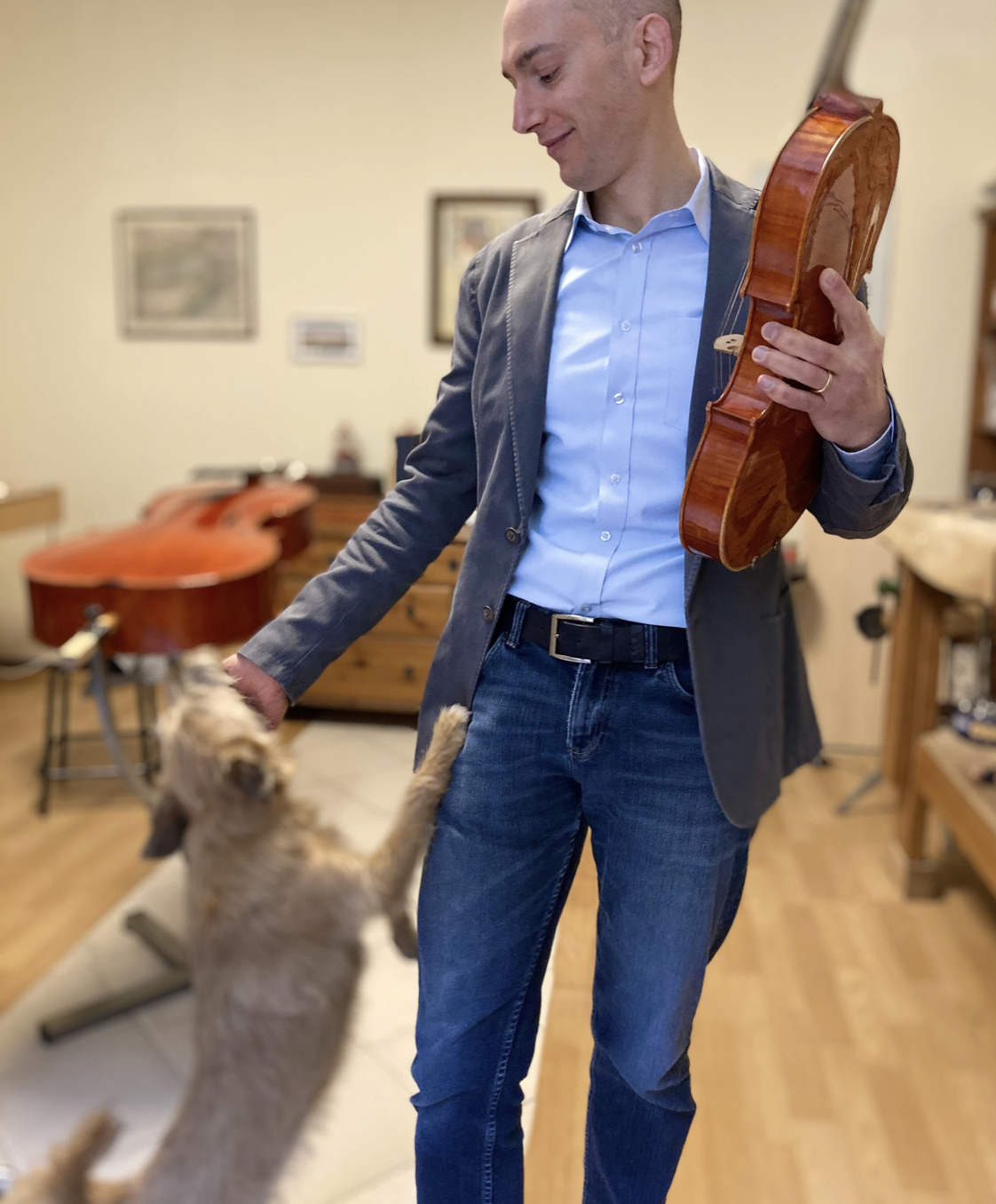
Marco Osio violinmaker workshop in Cremona, Italy
Welcome to my blog, written directly from my violin-making workshop in Cremona, Italy.
My name is Marco Osio, and I am a violin maker based in Cremona, the city where the great tradition of Italian violin making reached its highest expression through makers such as Amati, Stradivari and Guarneri.
Through this blog, I would like to take you behind the scenes of my work and share what it means to make a violin, viola or cello by hand today, while working within a tradition that has developed in Cremona over more than five centuries.
Violin making from the heart of Cremona
For me, violin making begins long before an instrument produces its first note.
It starts with the selection of the wood: spruce for the soundboard, maple for the back, ribs and neck, each piece chosen not only for its appearance but also for its physical and acoustic qualities.
From there, the instrument slowly takes shape.
The arching, thicknesses, bass bar, scroll, varnish and final acoustic adjustment are all part of a process in which countless individual decisions contribute to the character of the finished instrument.
Some of these decisions come directly from the classical Cremonese tradition. Others are the result of experience, observation and years of personal research.
This balance between tradition and individual interpretation is one of the aspects of violin making that continues to fascinate me most.
More than reproducing an old instrument
The great instruments of the past remain an extraordinary source of knowledge.
In my work, I often draw inspiration from classical Cremonese models by Antonio Stradivari, Giuseppe Guarneri “del Gesù” and the Amati family, studying their proportions, archings and construction principles.
But my aim is not simply to reproduce the past.
Every piece of wood is different, and every musician has a different way of playing, listening and searching for sound. A contemporary handmade instrument therefore has to develop its own identity.
I want each violin, viola and cello I make to have a clear personality: an instrument capable of responding to the musician and of continuing to develop through years of playing.
What you will find on this violin-making blog
I created this blog to share aspects of my work that cannot always be shown on a finished instrument page.
I will take you through different stages of the making process, including the selection of tonewoods, carving, arching, thicknessing, varnishing and acoustic adjustment.
I will also write about the instruments that inspire my work, historical Cremonese violin making, experiments carried out in the workshop, exhibitions and international violin-making events, and some of the questions musicians often ask me about contemporary instruments.
At times I may also share techniques and small details from the workbench — the kind of things that are difficult to explain without seeing how an instrument is actually made.
My intention is not simply to show the finished result, but to explain why certain choices are made and how they can influence the appearance, response and sound of an instrument.
Tradition, research and curiosity
Violin making is a centuries-old craft, but for me it has never been a static one.
Respecting tradition does not mean stopping experimentation.
I continue to study materials, varnishes, construction details and acoustic behaviour, comparing what I observe in historical instruments with what I learn from the instruments I make and from the musicians who play them.
This constant exchange between tradition, craftsmanship, acoustics and experience is what keeps my work alive.
Even after many years at the workbench, every new instrument begins with questions.
How will this particular piece of spruce respond?
How will the maple influence the character of the instrument?
How far can a classical model be interpreted while preserving its essential qualities?
And, above all, what kind of musical voice will emerge when the instrument is finally placed in the hands of a player?
From my workshop in Cremona to musicians around the world
Although every instrument begins here in my workshop in Cremona, its real life starts when it leaves the workbench.
My violins, violas and cellos are now played by musicians in different parts of the world, each developing a relationship with the instrument in a different way.
That is perhaps the most rewarding part of this profession: seeing wood, craftsmanship and an idea of sound gradually become a musical instrument with a life of its own.
Through this blog, I hope to bring you a little closer to that process.
Welcome to my workshop, and to my world of contemporary Cremonese violin making.