Violin Purfling: Its Function, Materials and Craftsmanship.
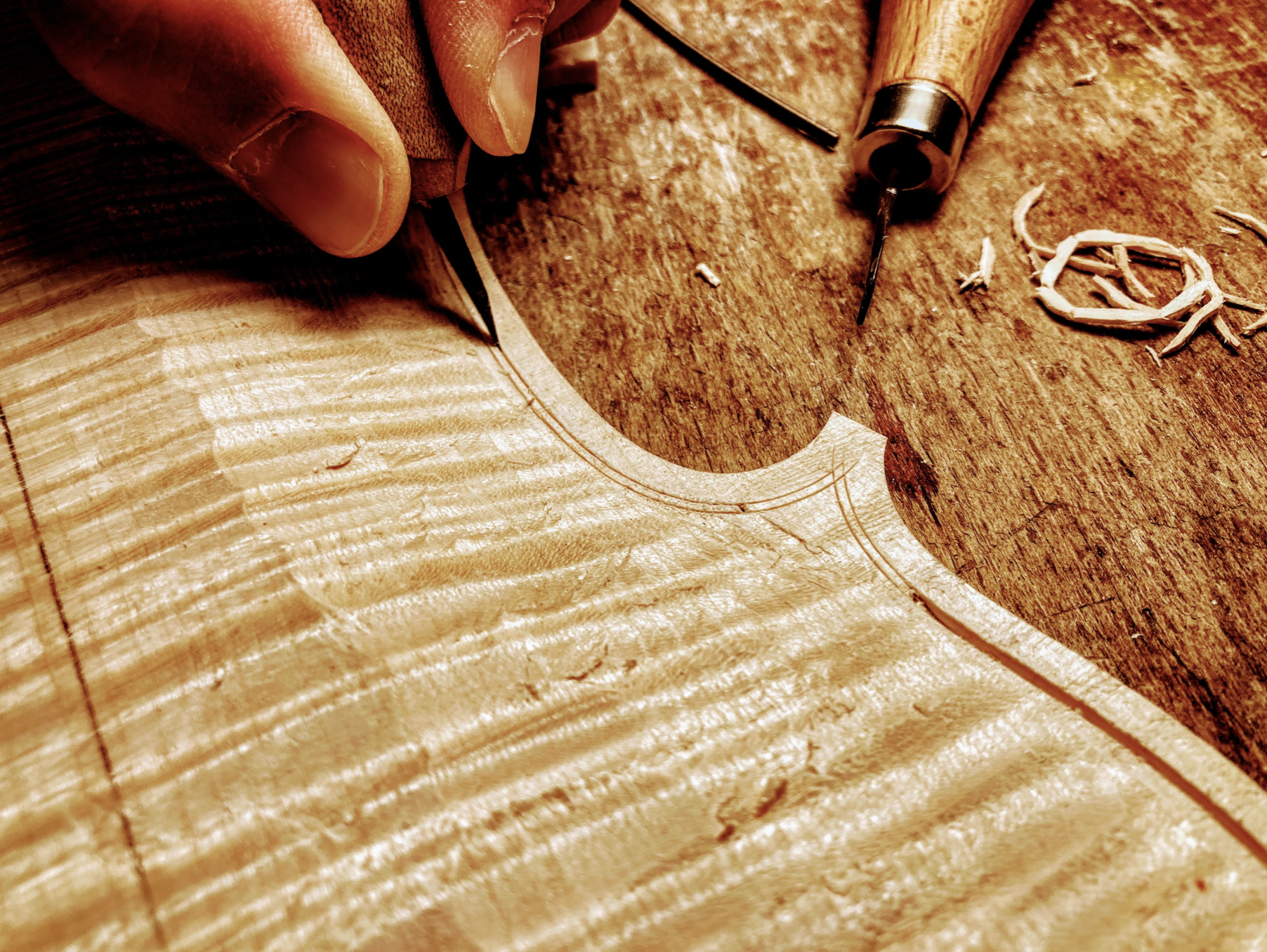
Direct from Cremona, the historic heart of violin making, I would like to take you inside one of the most delicate and characteristic stages in the construction of a violin, viola or cello: purfling.
Purfling is the narrow decorative inlay that follows the outline of the top and back plates of a stringed instrument. Although it is often admired first for its visual elegance, its role is not purely decorative. In traditional violin making, purfling also contributes to the protection and structural integrity of the instrument’s edges.
What is purfling in a violin?
Traditional violin purfling is usually made from three very thin strips of wood: a light-coloured central strip bordered by two darker strips.
This three-part construction is often associated with classical Cremonese violin making, although the exact materials, proportions and style can vary considerably from one maker or school to another.
Maple, poplar and pearwood are among the woods traditionally used for purfling. The black strips may be made from naturally dark wood or from wood that has been dyed.
The final appearance may seem simple, but producing a clean, elegant line requires great precision.
What is the purpose of purfling?
Purfling has both an aesthetic and a practical function.
From a visual point of view, it frames the outline of the instrument and helps define the character of the corners, curves and edgework.
Structurally, the purfling channel interrupts the grain close to the edge of the plate. This can help limit the propagation of cracks caused by impacts to the edge, an area of the violin that is particularly exposed during use.
Purfling should therefore not be considered simply as decoration. It is part of the constructional language of the instrument and must work in harmony with the edge thickness, channel and arching.
How purfling is made
In my workshop in Cremona, the purfling process begins by carefully marking its position around the perimeter of the instrument.
A narrow channel, approximately 1.2 mm wide, is then cut by hand into the spruce top and maple back.
This operation requires particular care around the corners and the C-bouts, where even very small variations can noticeably change the visual character of the instrument.
The three-part purfling strip is then bent to follow the curves of the outline and carefully fitted into the channel before being glued in place.
The aim is not simply to make the strip fit.
The purfling must follow the outline naturally, with clean mitres at the corners and a sense of continuity throughout the entire instrument.
Purfling and the style of a violin maker
Purfling is also one of the details through which the style of a violin maker can be recognised.
Its distance from the edge, thickness, curvature and the way the corner mitres are formed can reveal a great deal about a maker’s approach.
When studying historical instruments by makers such as Stradivari, Guarneri and Amati, these seemingly small details become particularly fascinating.
The purfling is never isolated from the rest of the design. It interacts with the corners, edgework and arching, contributing to the overall balance and personality of the instrument.
A small detail with a major role
Purfling occupies only a very narrow part of the instrument, yet it requires time, experience and careful control of the tools.
For me, it is a perfect example of what makes traditional violin making so compelling: a detail that combines function, craftsmanship and beauty.
It is through details like these that a violin, viola or cello gradually acquires its own identity.
From the workshop in Cremona, each stage of construction contributes to the final instrument — not only to the way it looks, but also to the way it will eventually come to life in the hands of a musician.