Mountain Maple in Violin Making: Beauty, Structure and Sound
From my workshop in Cremona, today I would like to focus on one of the most characteristic woods used in violin making: mountain maple, often referred to as Balkan or Carpathian maple.
It is the traditional choice for the backs, ribs and necks of violins, violas and cellos, appreciated not only for its acoustic qualities, but also for the beauty of its figure.
Why is maple used in violin making?
Mountain maple offers a combination of stiffness, strength and relatively low weight that makes it particularly suitable for stringed instruments.
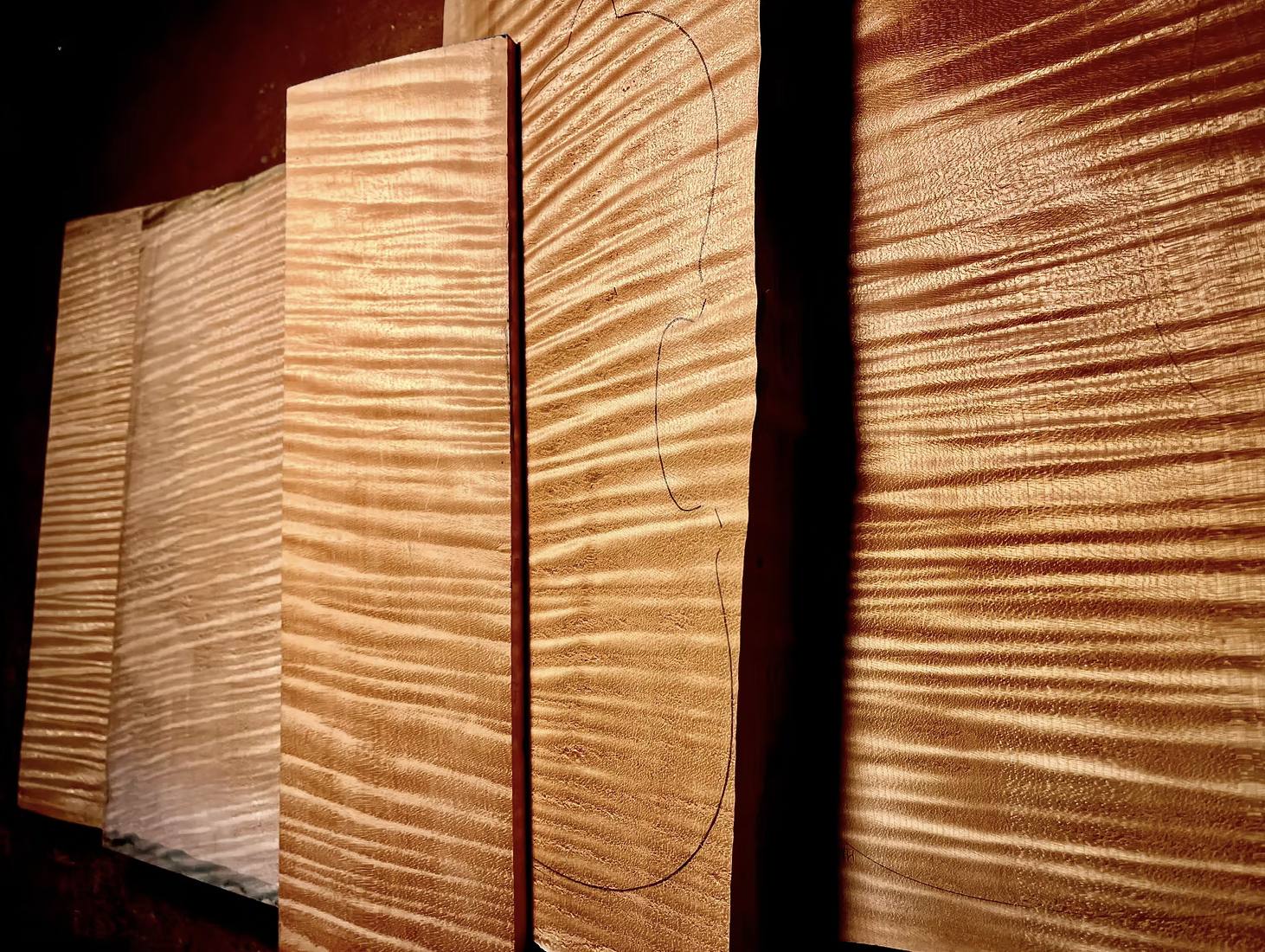
It also has an unmistakable visual character. Depending on the cut and growth of the tree, the wood can show a more or less pronounced flame, creating the changing reflections that are so strongly associated with classical violin making.
Its colour usually ranges from pale cream to light golden tones, while the final appearance is greatly influenced by the ground and varnish applied by the maker.
Is maple the only wood used for backs and ribs?
No.
Historical and contemporary instruments have also been made using woods such as poplar, willow and field maple, sometimes with excellent results.
This is particularly common in violas and cellos, where alternative woods can offer interesting acoustic and visual characteristics.
Mountain maple, however, remains the most widely used choice because it combines predictable working properties, structural strength and a long-established relationship with the classical Cremonese tradition.
What I look for in a piece of maple
When selecting maple, appearance is important, but it is never the only consideration.
I look closely at the grain, density, stiffness and general character of the wood.
Personally, I often prefer maple with relatively regular growth and an even flame. This gives me a more predictable material to work with and allows me to make more controlled decisions during carving and thicknessing.
At the same time, every piece is different.
The role of the violin maker is not to force all wood to behave in the same way, but to understand the material and adapt the construction accordingly.
Does beautiful maple make a better-sounding violin?
Not necessarily.
A spectacular flame can make an instrument visually striking, but acoustic quality cannot be judged from appearance alone.
The final sound depends on the interaction between many elements: the density and stiffness of the wood, the model, arching, thicknesses, varnish and setup.
This is why the choice of wood is only the beginning.
For me, good maple provides the foundation. What matters next is how that material is shaped and combined with the spruce soundboard to create the response and tonal character of the finished instrument.
A material with its own personality
High-quality mountain maple has become increasingly valuable and carefully selected wood is not always easy to find.
For this reason, I consider good tonewood something to be chosen patiently and kept until the right instrument comes along.
In my work in Cremona, the aim is never simply to use the most visually impressive piece of maple.
It is to choose the piece whose structure, weight, figure and mechanical properties best suit the instrument I want to make.
The beauty of maple is immediately visible.
Its real value, however, appears only when the wood, the design and the work of the maker begin to function as one.