By Marco Osio, violin maker in Cremona · 3-minute read
Yes. In two listening tests in my Cremona workshop, violinist Angela Kang and I heard a difference in tone when we switched between a traditional violin bridge and a new design by Despiau. You can hear both comparisons below.
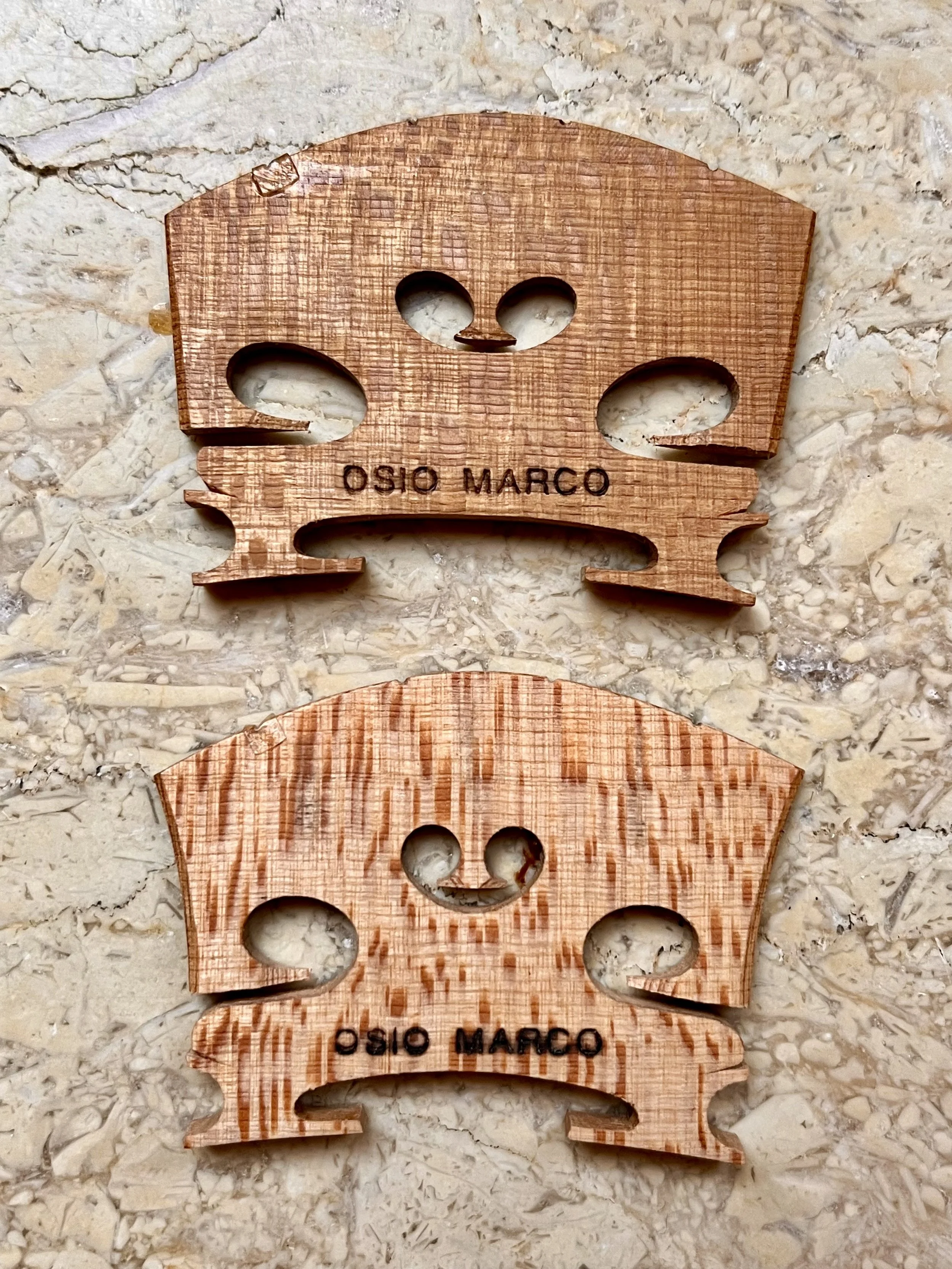
Traditional violin Bridge and innovative violin Bridge
What first caught my eye about the Despiau bridge was its outline. It reminded me a little of a Baroque bridge. I wanted to hear how one of my own violins would sound with it, so I fitted one to a violin I had made after Guarneri del Gesù’s 1743 “ex Brusilow”. Later, Angela and I repeated the comparison on a second violin, this time a Giuseppe Ornati model.
In each video, you hear Angela play the same violin with two different bridges. If you have headphones handy, I suggest listening before reading our impressions.
First listening test: the Guarneri del Gesù “ex Brusilow” model
On my Guarneri del Gesù model, Angela played an excerpt from the Romance, the second movement of Wieniawski’s Violin Concerto No. 2. The long phrases give you time to listen beyond the first instant of a note and hear how its colour develops as the bow moves.
[Video 1: Angela Kang plays Wieniawski on the Guarneri model with the traditional and Despiau bridges.]
On a second listen, try choosing one phrase you like and finding it in both versions. Keep the volume the same. I find it useful to follow a sustained note in the middle of the phrase: once I know the melody, I can give my attention to the sound itself. Which version would you want to hear for the rest of the Romance?
Second listening test: the Giuseppe Ornati model
The first comparison left me with a question: would Angela and I hear the same difference on another violin? For the second test, I chose the Ornati model that completed the series I made to celebrate my 25th anniversary as a violin maker.
[Video 2: Angela Kang plays the Ornati model with the traditional and Despiau bridges.]
These were the first notes played on the finished Ornati. On the Guarneri, I had been listening for a change in a voice I already knew. Here I was getting to know the violin itself as Angela played it with each bridge. If you preferred one version in the first video, do you find yourself making the same choice here?
What Angela and I heard
If a colleague asked me what struck me first, my answer would be the same for both violins: with the Despiau bridge, the sound seemed richer in overtones. Angela had the same impression under the bow that I had listening to her.
Overtones are the higher components that sound along with the fundamental note. Together they help give a violin note its particular colour. “Richer in overtones” is how we would describe what we heard; it was a listening impression, not an acoustic measurement.
Which bridge did I keep?
After I shared the recordings on YouTube, listeners told me which version they preferred. I also heard from musicians who tried the violins themselves at fairs and exhibitions. For each violin, about 75% of those who expressed a preference favoured the new Despiau bridge. These were informal responses, from people listening to a recording as well as players who could feel the instrument respond to their own bow.
My choice was clear: I kept the Despiau bridge on both violins. Its outline was what first made me curious. What persuaded me to keep it was hearing that richness on the Guarneri, then hearing it again when Angela played the Ornati.
Did a particular note or phrase catch your ear? If you’d like to share what you heard, or ask me about either violin or how I fitted the bridges, feel free to write to me. I’d be happy to hear your impressions and answer your questions.