The Bass Bar: The Hidden Structure Behind a Violin’s Sound
From my workshop in Cremona, today I would like to focus on one of the most important internal parts of a violin, viola or cello: the bass bar.
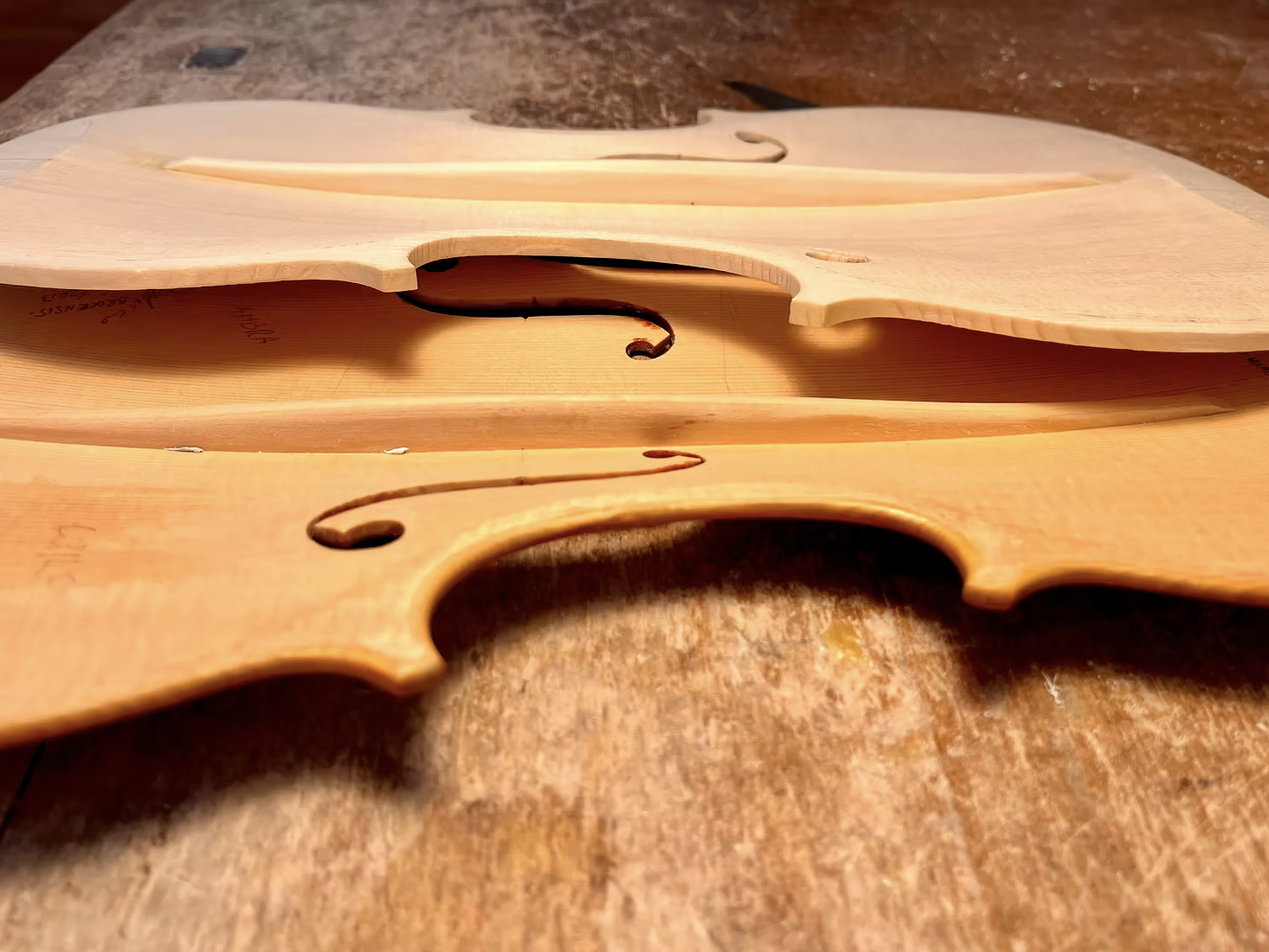
Hidden beneath the soundboard, on the bass side of the bridge, this narrow strip of spruce has two essential functions: it helps support the top plate under string pressure and influences the way vibrations travel through the instrument.
Why is the bass bar so important?
The bass bar works together with the soundboard, bridge and soundpost.
Its size, shape, stiffness and position can influence response, projection, tonal balance and the way the lower register develops.
This is why it cannot be treated as a standard component.
Every soundboard has different density, stiffness and elasticity, so the bass bar must be adapted to the individual instrument.
Choosing the wood
For my bass bars, I use carefully selected split spruce.
I pay particular attention to weight, stiffness and grain, and I try to choose wood whose mechanical characteristics work naturally with the soundboard.
The goal is not simply to make the bar strong.
It must provide enough support while still allowing the top plate to vibrate freely.
A detail that has evolved over time
Historical bass bars were generally shorter and lighter than those used in modern instruments.
As string tension, bridges and playing requirements changed, bass bars also evolved.
Today, their dimensions and construction are designed to provide greater support and stability while preserving acoustic freedom.
Precision matters
The bass bar is fitted and glued directly to the inside of the soundboard, and even small differences in shape or tension can affect the final result.
For me, this is one of the stages where the maker’s judgement becomes especially important.
The correct bass bar does not make an instrument sound good by itself, but it allows the soundboard to work efficiently as part of the whole system.
Like many details in violin making, it is almost invisible from the outside — yet its influence can be heard in every note.