What’s Behind a Violin Maker’s Label?
Inside every violin, viola or cello there is usually a small label.
It may seem like a simple piece of paper, but in contemporary violin making it can tell you something very important:
who made the instrument, where it was made, and who takes responsibility for it.
From my workshop in Cremona, I see the label as the final signature on a much longer process.
More than a name
When I place my label inside an instrument, I am not simply identifying it.
I am confirming that the instrument was made in my workshop and that I stand behind the choices involved in its construction — from the selection of the wood to the arching, varnish, setup and final acoustic adjustment.
For a musician or collector, this gives the instrument a clear and traceable origin.
With a contemporary instrument, it is often possible to know not only the maker’s name, but also the year of construction, the model, the materials used and, in some cases, to document different stages of the making process.
Why provenance matters
A label by itself is not proof of authorship.
Historical violin making offers countless examples of labels that were copied, replaced or inserted into instruments made by someone else.
For this reason, attribution should never depend on a label alone.
With a contemporary handmade instrument, however, provenance can be much clearer.
Certificates, photographs, workshop records, direct contact with the maker and documentation of the construction can all help establish the identity of an instrument from the beginning.
This transparency becomes increasingly valuable as the instrument grows older.
Knowing who actually made the instrument
For me, one of the advantages of choosing a contemporary violin is precisely this direct connection.
A musician can meet the person who made the instrument, visit the workshop and understand how it was constructed.
In some commissioned instruments, clients can also follow parts of the making process — from the choice of wood to varnishing and final setup.
Watch the video: Inside the Making of a Violin in My Cremona Workshop
This does not change the sound of the instrument, of course.
But it changes the relationship with it.
You know its origin, the hands that made it and where to return if, years later, adjustment, maintenance or documentation is needed.
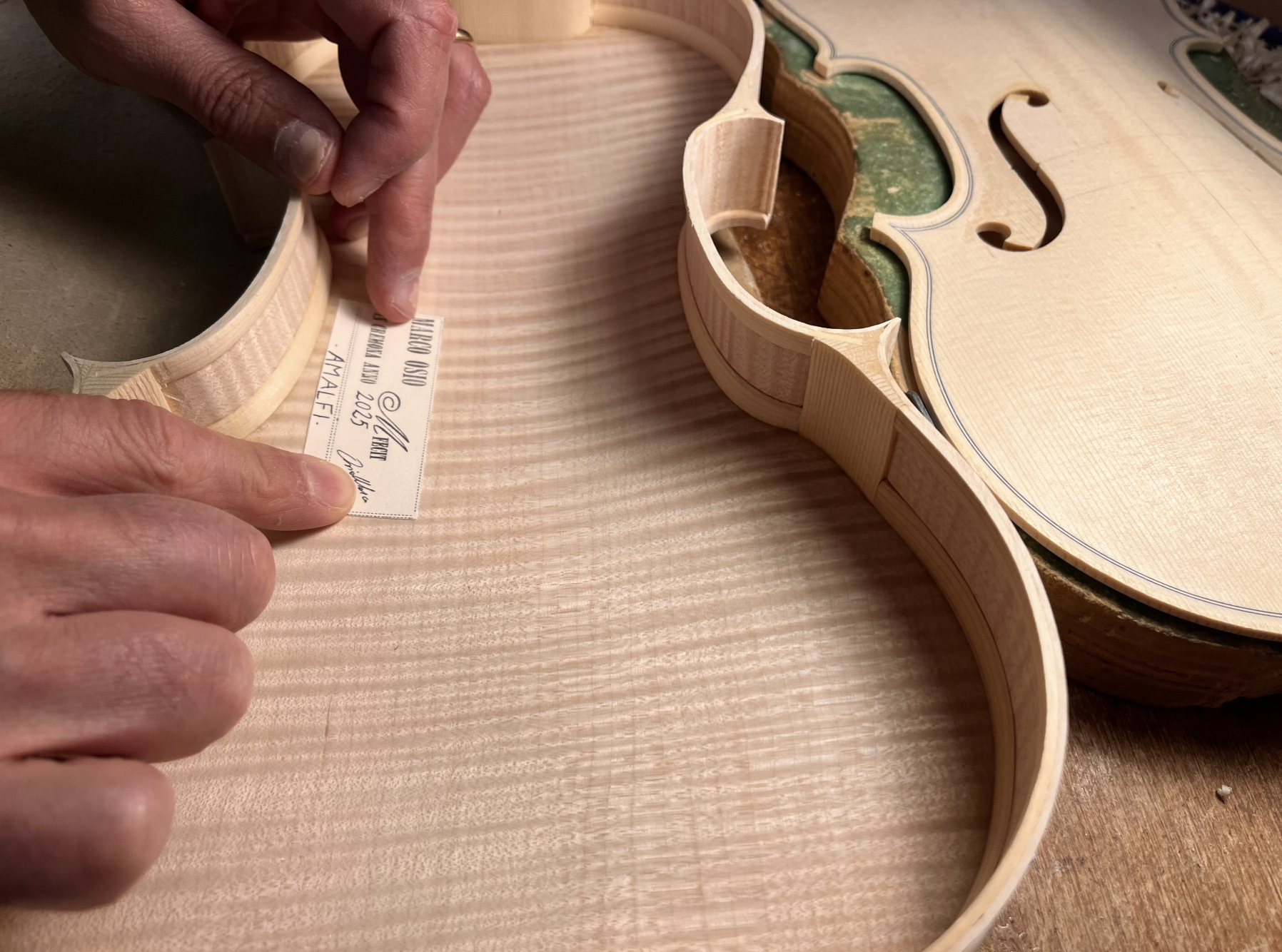
A signature and a responsibility
For a violin maker, a label should represent more than authorship.
It represents responsibility for the work.
When my name and Cremona appear inside an instrument, I know that they may still be there many decades from now.
That is one reason I believe contemporary violin making should be as transparent and traceable as possible.
The label is small.
What stands behind it — the maker, the workshop, the craftsmanship and the instrument’s provenance — is much more important.